

Buying guide8 min
Shahabad, Tandur and Dove Grey — why the same stone has three names
Shahabad, Tandur and Dove Grey can describe material from the same limestone belt. Geography, merchant naming and colour shorthand explain the overlap.

One limestone belt, several trading names
Shahabad, Tandur and Dove Grey are often treated as separate products in catalogues, yet the names overlap because they grew from different parts of the supply chain. The limestone comes from the same broad geological belt across adjoining parts of southern India. Shahabad is the established quarrying and trading name on the Karnataka side, while Tandur is the corresponding name widely used on the Telangana side. Stone does not change at a state boundary, so beds across this belt can share the dense structure, layered character and muted colours buyers associate with the material. A geographical label therefore tells a buyer where a supplier places the material commercially, but not everything about the individual bed.
In the UK and European trade, merchants also use Tandur and Dove Grey for this same material. Dove Grey is a market-facing colour name rather than a separate geological classification. Grey material may consequently appear as Shahabad Grey, Tandur Grey or Dove Grey, while yellow material is commonly traded as Shahabad Yellow or Tandur Yellow. These names can all be legitimate, but they are not a substitute for confirming the actual colour range, quarry source and finish. The safest buying practice is to regard the name as the start of the specification and the approved production range as the specification itself.
How the naming developed
Natural stone names rarely follow a single international system. A quarry may name stone after the nearest established town, a processor may use the district from which blocks arrive, and an overseas merchant may choose a colour name that customers understand immediately. Once architects, installers and stockists recognise a term, it persists even when material is sourced from another part of the same belt. Tandur became familiar in export markets, while Dove Grey gave merchants a simple description for the quieter grey selection. Shahabad remains especially relevant to material quarried and processed from the Karnataka side. None of these conventions is unusual in the stone trade.
Confusion starts when a commercial name is presented as proof of uniformity. A broad belt contains multiple beds, and each bed can vary in background tone, shell or fossil markings, fine veining, cleft character and the frequency of warmer or cooler pieces. Two suppliers can both quote authentic Tandur Grey and offer visibly different selections. Equally, a Shahabad Grey sample and a merchant's Dove Grey board may be closely comparable because they come from similar beds and have received the same finish. Buyers should avoid arguments about which name is uniquely correct and instead ask which source and production standard sit behind the name being quoted.
Colour names are ranges, not paint codes
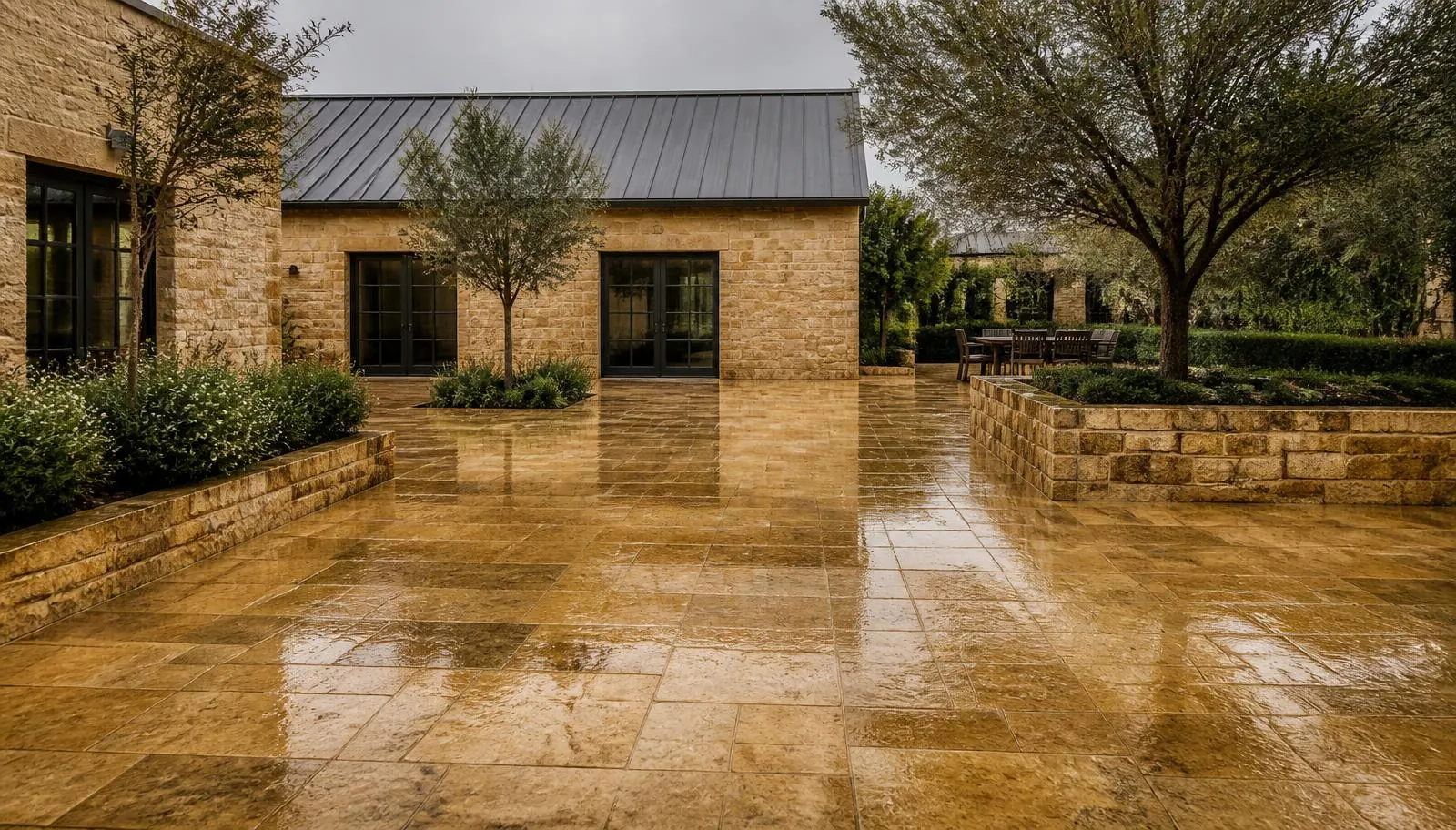
Grey limestone from this belt is generally selected for a restrained grey to blue-grey appearance, but natural tonal movement remains normal. Surface texture, moisture and lighting can make the same piece look cooler, darker or more variegated. A riven face casts small shadows and exposes the bedding plane; honing makes colour read more evenly; wet stone usually appears deeper. Dove Grey may suggest a narrow, pale palette to a retail customer, but a shipment of natural stone cannot be judged like a manufactured tile with a printed design. The expected range needs to be shown in several dry and wet pieces at the ordered finish.
Yellow material illustrates the same point. Tandur Yellow and Shahabad Yellow describe selections with buff, beige, ochre and occasional warmer movement rather than one fixed yellow. Reddish and blue-grey selections can also occur within the wider producing area. Sorting can narrow a range, but tighter selection normally affects recovery, availability and price because more production must be set aside. A responsible supplier will describe likely variation and agree what is acceptable rather than promise impossible uniformity. Buyers should record whether mixed tones, strong markings, edge variation or occasional contrasting pieces are included, especially when replenishment must blend with an earlier delivery.
What to put on an enquiry and order
Use both the commercial name and an unambiguous physical description. An enquiry might identify Shahabad Grey, also sold in the destination market as Tandur Grey or Dove Grey, then state the dimensions, thickness tolerance, face finish, edge finish and intended application. Add reference photographs or an approved range sample, but make clear whether a small sample establishes colour direction only or represents a formal selection standard. Ask the supplier to identify the producing area and whether one quarry bed or a controlled blend will be used. This creates a better record than relying on a short product name repeated across emails and invoices.
The purchase order should also address natural characteristics. Agree the acceptable tonal range, whether visible mineral lines or fossil markings are normal, and how repairs or filled features will be treated. State how pieces are to be counted, calibrated, inspected and packed. If a local sales name must appear on labels, keep the source name in the technical description so warehouse staff and future buyers can trace the material. Photographs of laid projects are useful for understanding overall character, but they are affected by weather, sealers, cameras and screens. Current batch photographs and physical samples are more reliable for approval.
How to compare offers that use different names
First align the measurable parts of the offer: nominal and actual size, thickness and tolerance, finish, edge treatment, quantity, packing method and commercial terms. Then compare colour selections using equivalent samples. A honed Dove Grey sample cannot fairly be compared with a wet riven Tandur Grey photograph, because finish and moisture change the appearance. Ask for images taken in neutral daylight with multiple pieces visible, including the ordinary production range rather than one chosen tile. If possible, review samples from current production and retain signed or clearly labelled references for the order file.
Price differences do not prove that one name is superior. They can result from bed yield, selection strictness, processing, packing, order efficiency, currency, inland movement and the seller's service. Conversely, matching names do not prove matching quality. One offer may include careful calibration and export packing while another leaves those points undefined. Compare the complete specification and the supplier's willingness to document it. If substitution is allowed, require written approval before a different bed or colour selection is used. That discipline matters more than whether the invoice leads with Shahabad, Tandur or Dove Grey.
A practical way to explain it to customers
Merchants can explain that Shahabad and Tandur are place-linked names from opposite sides of the same limestone belt, while Dove Grey is a familiar UK and European trading name for the grey material. This is clearer than claiming three unrelated stones or insisting that every piece sold under the three labels is identical. Follow the explanation with the actual approved range. Customers usually accept natural variation when they see it before purchase; problems arise when a poetic colour name creates an expectation of manufactured consistency.
For repeat business, keep a record of source, finish, dimensions, batch images and approval samples rather than only the sales name. If a later phase must match, tell the supplier early and expect some difference because quarry beds and production runs evolve. Order sufficient attic stock where replacement matching matters. Naming is useful for discovery and marketing, but traceable specification protects the buyer. Once the source and range are documented, the three-name issue becomes straightforward: the labels describe overlapping trade traditions, and the delivered stone is judged against the agreed material.
Key takeaways
- Shahabad and Tandur refer to the Karnataka and Telangana sides of the same limestone belt.
- UK and European merchants use Tandur and Dove Grey for the same material; grey is also sold as Tandur Grey.
- Approve a colour range, source and finish rather than relying on a trading name.
- Keep source and batch records for repeat orders and future matching.
More from the journal
Related stones and reading
Compare the current Shahabad range
Ask for representative samples and a quotation matched to your required colour, dimensions and finish.